|
|
 |
Llanerch are a country publishing company based in rural Wales. We specialise in small print editions and facsimile reprints of old books and ancient texts, many of which have been painstakingly translated from the original language. Our wide range of books cover many historical periods and subjects and are available to order through the catalogue. |
| |
Browse the catalogue by choosing a theme from the left hand menu. Llanerch Press have added a number of new books to the online catalogue and can be seen below. Our books can be ordered online and shipped anywhere in the World. |
| |
|
| |
| Below are recent additions to our catalogue. |
| |
|
| |
"The Welsh House"
The Welsh House, a beautiful Hardback limited edition. Only 1500 copies available, order yours online now.
Click Here to order this new book.
From the great half-timbered halls of the east to the humble thatched cottages of the west, Wales has a remarkably rich heritage. Every area of the Principality has unique building traditions, details of which are celebrated here in this study of folk culture. Researched by field survey in the 1930s, The Welsh House captures building traditions that had died centuries before in other parts of Britain. As well as recording the traditional cottages and farmsteads of Wales, this work demonstrates that houses are an important record for the social historian, for they reflect the lives of the people that made them.
Since its publication in 1940 The Welsh House has grown into a classic text for students of both Welsh architecture and folk studies. Peate describes the traditional homes of Wales in an accessible manner, using photographs and illustrations to record a world that was fast disappearing. His warm and competent description and warning against the loss of traditional buildings remains as relevant today as when it was first published over sixty years ago.
This new edition preserves Peate's text from the revised second edition of 1944, and adds a new foreword by Greg Stevenson. This additional material traces the fate of the homes in the original and examines the present day threats to the vernacular architecture of Wales. It will be of interest to anyone living in, or curious to learn more about, the rich architectural heritage of Wales. It is published in a numbered edition of 1500 copies.
Dr Iorwerth Cyfeiliog Peate (1901 -1982) was an internationally recognised expert in folk studies, and is well known for his pioneering work recording, preserving and publishing on Welsh folk culture. He wrote 'The Welsh House' when employed as the Keeper of the Department of Folk Culture and Industries in the National Museum of Wales, and later went on to become a key player in establishing the Welsh Folk Museum (now the Museum of Welsh Life, St Fagans). Peate's unstinting dedication to the recording and preservation of Welsh cultural heritage won him lasting respect inside and outside of Wales.
Dr Greg Stevenson lectures in Welsh Heritage at the University of Wales, Lampeter, and manages a small business rescuing historic buildings at risk. He writes a regular column for The Western Mail on historic Welsh architecture. Visit him at www.thisisgreg.co.uk
Cover: Yr Hen Siop, Treteio, St David's. Restored in 2001/2 by Richard Cotton. Courtesy: Cadw
|
| |
|
| |
|
The Archer's Craft
The book by Adrian Eliot Hodgkin was first published as a large format edition in 1951. This photo-reduced paperback reprint has been produced in response to the growing interest in archery and the traditional skills employed in the archers craft. It is an invaluable guide for those who wish to make bows, especially longbows, arrows and other archers tackle, the traditional way. Although Hodgkin's book was originally written for hunters, the practice of hunting with the bow is now illegal in the United Kingdom, and the interest nowadays is more commonly in target practice and competitions, as well as reenactments of mock battles.
Included in this edition are numerous useful illustrations to assist those wishing to make their own archery equipment.
The author's chapter on hunting with the bow has been included for historical interest only, especially as it contains accounts from the fourteenth-century Book of Roi Modus, and the Livre de Chasse.
|
| |
|
| |
|
The Adventures & Vagaries of Twm Shôn Catti
The first edition of Prichard's Adventures and Vagaries of Twm Shôn Catti was published by its author in 1828. Although written in English, it came to be recognised as 'the first Welsh novel' and its success and recognition encouraged the author to bring out revised and enlarged editions that were published in 1839 and, posthumously, in 1873. The later editions were more sophisticated, and corrected for the sake of historical accuracy, but lacked the vitality of the first, which the Oxford Companion to the Literature of Wales (1986) describes as 'employing traditional material which retains the pleasing freshness and simplicity of folk-tale.' Thus, despite the lack of sophistication, a reprint of the first edition is warranted not only as a record of the 'first Welsh novel' but also because it has a freshness and vitality all of its own. It is not a book of history but a novel based on oral folk-tradition; it should be read for enjoyment, as a celebration of a national hero of Wales. Twm, a wayward escapade-loving youth who makes good, is presented as the hero of the tale; he is an attractive character who even in his worst dealings never acts from personal greed.
Front cover photo: Dinas hill where Twm once hid in a cave.
|
| |
|
| |
|
The Folklore & Provincial Names of British Birds
Charles Swainson's book is an invaluable reference work for ornithologists and students of folklore alike, for it brings together in a single compact volume information which is otherwise scattered across the literature of Britain, Europe and the Middle East, much of it long out of print or found only in the great reference libraries, where we can be directed via his extensive bibliography spanning the seventeenth, eighteenth, and nineteenth centuries.
The birds appear species by species. Names are given in Latin, common English, and regionally, and generally with derivations. (Frequently also given in Gaelic, French, German and Norwegian). Alongside this there are rare and fascinating snippets of folklore and also more detailed extracts from the folk and other literature of Britain, North Western Europe and even as far and diverse as the Apocryphal gospels and occasional Arabic sources. For an example closer to home, he illustrates the various practices used in differing locations, to dispel the ill luck caused by the appearance of a single magpie; from making a cross in the air, removing your hat and making a polite bow, crossing the feet, hoping for sight of a crow, or spitting over your right shoulder whilst thrice repeating a certain given rhyme.
To fully appreciate the value of this work it should be kept in mind that this was written at a time when the author had plentiful access to living folklore which has subsequently been lost or long forgotten.
First published in 1886 by Eliot Stock, this present work is a facsimile reprint of that edition.
|
| |
|
| |
|
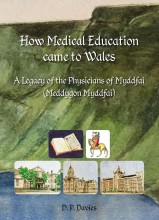
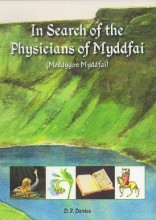
The Physicians of Myddfai
This unique work is of great value to anyone interested in both herbal medicine and the folk traditions of Wales. Although the material dates back to the twelfth century, it is still recognized as a useful and relevant text by present day practitioners as well as those with a more historical perspective.
The original physicians of Myddfai date from the twelfth century and their remedies have come down to us in two books, originating from the descendants of Rhiwallon the physician, a short one named The Physicians of Myddfai and a much longer one attributed to Howel the physician. The two books are included in this present collection, together with the famous legend of Llyn-y-Van which claims that Rhiwallon was taught his medicinal art by his estranged mother, the mysterious Lady of the Lake, who predicted his family would be the most skilful physicians in the country for many generations.
Whatever one thinks of the legend printed here, it is a fact that the descendants of Rhiwallon became notable physicians and that as late as the 19th century more than one royal surgeon originated from the little village of Myddfai. The last known practitioner in Wales seems to have been Rice Williams M.D. of Aberystwyth, who died in 1842 aged 85.
This present collection is a facsimile of the English text first published in Llandovery in 1861 and translated into English by John Pughe. From an index spanning Abdominal complaints to a variety of Wounds, this work advises treatments on hundreds of conditions, sufficient to fascinate any reader.
|
| |
|
| |
|
| | | The Chronicle Of The White Rose Of York, 2 Vols. | Author: Edited by J. A. Giles |
The historical documents making up this collection were written in the vernacular language in the re..... | | | | The Illusion Which Sees The One As Two | Author: Tim Bowles |
Timeless wisdom and recent science co-star in this book because, amazingly, they paint similar pictu..... | | | | The Lake Dwellings of Ireland | Author: W. G. Wood-Martin |
This is a facsimile reprint of an archæological classic on the crannogs or lake dwellings of Ireland..... | | | | THE WATER OF LIFE: Springs and Wells of Mainland Britain | Author: Ian & Frances Thompson |
THE WATER OF LIFE:
SPRINGS AND WELLS OF MAINLAND BRITAIN
A new approach to the subject, offering
..... | | | | Welsh Poems and Ballads | Author: George Borrow |
In a collection of unedited odds and ends from Borrow's papers bearing upon Wales, and dating from v..... | | | | Y Seint Greal - The Welsh Holy Greal | Author: Robert Williams |
There are two Arthurs. The Arthur of history is known from early Welsh poems, and he is probably the..... |
| |
|
| |
|
|