Llanerch are a country publishing company based in rural Somerset, England. We specialise in small print editions and facsimile reprints of old books and ancient texts, many of which have been painstakingly translated from the original language. Our wide range of books cover many historical periods and subjects and are available to order through the catalogue.
Browse the catalogue by choosing a theme from the left hand menu. Llanerch Press have added a number of new books to the online catalogue and can be seen below. Our books can be ordered online and shipped anywhere in the World.
Below are recent additions to our catalogue.
The Bardic Monk
When Henry II of England, in thrall to tales of King Arthur, travels to a remote corner of Wales to meet with a shrouded monk of no name, he is hoping to trace the final resting place of his hero ancestor. In this fascinating tale, as mythical in its telling as any Arthurian legend, once the King has the knowledge he needs from the Bardic Monk, he sends his envoy Walter Map to Glastonbury, to meet with his friend Gerald of Wales and experience a compelling and historic drama.
A Mozart Jigsaw
This imaginative work, part serious, part humorous, written by an amateur enthusiast, centres around aspects of Mozart's short life. It looks at him from many viewpoints and demonstrates why, at a distance of more than two hundred years, we are still fascinated and inspired by the quality of his music. His enthusiasms, his foibles, his quirkiness and his genius are captured herein so that we gain further glimpses of his personality. This 'Mozart Jigsaw' looks at him through the eyes of some of the people he met in his short life; some with humour, some with jealousy, some with kindness, some with envy, many with admiration. As such, it may give an incomplete but nevertheless an entertaining picture of this genius and shows the continuing appeal of a composer with a God-given talent.The book includes sketches and colour cartoons drawn by the author.
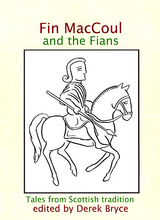
Fin MacCoul and the Fians
These tales were collected from the Gaelic oral tradition in the nineteenth century by J.F. Campbell, D. MacInnes and J.G. Campbell who translated the into English. A selection of them is presented here, set in a more modern style of English, and this book is not aimed at scholars but is for the average intelligent reader who wishes to catch a glimpse of what was the popular entertainment in the Highlands and Islands before the coming of widespread written lieracy and the mass media. Fin is, in fact, better known in Ireland, and some think that the tales of him came to Scotland with the spread of Gaelic, but there are stories implying that he spent part of his life in Scotland and the Isles. Fin was not just a warrior chief but a leader that had wisdom and all the qualities that make for true nobility; and THAT is what made him famous.
The Life and Times of Thomas of Ercildune (The Rhymer)
Sir Thomas Learmonth, True Thomas and Thomas the Rhymer; he is known by all three names. For those of you who are unfamiliar with any of these, here is a brief history. Thomas signed his name Thome de Ercildune and he was born early in the thirteenth century in Ercildune, a small hamlet in the lowlands of Scotland. By all accounts, he was as normal as the next man, until a chance meeting with a beautiful lady at the foot of the Eildon Hills near Melrose changed his life forever.According to the legendary "Ballad of Thomas the Rhymer" the lady was the "Queen of Fair Elfland". The ballad tells that Thomas made love to the Fairy Queen seven times and was then bound to serve her in her own country for seven years. Fortunately for Thomas, the Queen does not deliver his soul to the devil, but returns him safely to the spot where they first met at the "Eildon Tree". Before they depart, the Fairy Queen bestows the gift of prophecy on Thomas, and from that moment, until his mysterious disappearance near the end of the thirteenth century, Thomas foretells many events which have mostly all subsequently come to fruition; his prophecies were unrivalled until the time of Nostradamus.
The book explores the basis of the lore and superstitions which were prevalent in his day, these being handed down through many generations from the times of the indigenous tribes. It also explains the formation of the country we now know as Scotland; the blend of tribes, languages, and cultures which ultimately united - or segregated - the people of the new nation. The life of Thomas, who was allegedly a great ally of King Alexander III, was further complicated by the King's untimely death in 1286. The events which followed ultimately led to the first "War of Independence", during which, according to written reports , Thomas befriended King Edward I greatest antagonist, William Wallace. The historical facts are explained in the book, as is the credibility of the words of the ballad as contained in the early manuscripts; five of which remain today.
Included, are transcripts from the five extant manuscripts which are explained in detail, two new poems dedicated to Thomas, and a 2011 version of the complete ballad and prophecies, taken almost word for word from the early "Quant Englis" version of the manuscripts and transcribed into present day English.
Included are colour pictures of present day sites relevant to the book.
The Candidate
Will Hamley is a first-time novelist whose experiences of being on the fringe of politics in South Wales in the 1950's are captured in this novel about a man facing the prospect of becoming the Labour Party candidate for an upcoming election.Pontavon, a town which though fictional bears a remarkable resemblance to many another in the South Wales Valleys is full of characters from the reddest of red, to the weirdiest and oddest imaginable.
This is the story of one man's journey, and though it references political struggle it is by no means a political polemic. In fact throughout the book the actual political issues are kept cleverly in the background. It is rather the manipulations, the personal betrayals, the little white lies, and the human cost to a family when a man makes a choice to play a role in the public eye. It is this which turns the book into a human story from a time in Wales's history which was by no means as innocent as memory sometimes makes it.
Review by the Welsh Books Council - "A rollicking good read... Hamley paints his characters with almost 3D brilliance, as you turn the pages they become part of your life. Quite simply I did not want the book to end...this man can tell a tale and make you laugh."
The Welsh House - New paperback edition
From the great half-timbered halls of the east to the humble thatched cottages of the west, Wales has a remarkably rich heritage. Every area of the Principality has unique building traditions, details of which are celebrated here in this study of folk culture. Researched by field survey in the 1930s, The Welsh House captures building traditions that had died centuries before in other parts of Britain. As well as recording the traditional cottages and farmsteads of Wales, this work demonstrates that houses are an important record for the social historian, for they reflect the lives of the people that made them. Since its publication in 1940 The Welsh House has grown into a classic text for students of both Welsh architecture and folk studies. Peate describes the traditional homes of Wales in an accessible manner, using photographs and illustrations to record a world that was fast disappearing. His warm and competent description and warning against the loss of traditional buildings remains as relevant today as when it was first published over sixty years ago.
This new edition preserves Peate’s text from the revised second edition of 1944, and adds a new foreword by Greg Stevenson. This additional material traces the fate of the homes in the original and examines the present day threats to the vernacular architecture of Wales. It will be of interest to anyone living in, or curious to learn more about, the rich architectural heritage of Wales. It is published in a numbered edition of 1500 copies.
Dr Iorwerth Cyfeiliog Peate (1901 -1982) was an internationally recognised expert in folk studies, and is well known for his pioneering work recording, preserving and publishing on Welsh folk culture. He wrote ‘The Welsh House’ when employed as the Keeper of the Department of Folk Culture and Industries in the National Museum of Wales, and later went on to become a key player in establishing the Welsh Folk Museum (now the Museum of Welsh Life, St Fagans). Peate’s unstinting dedication to the recording and preservation of Welsh cultural heritage won him lasting respect inside and outside of Wales.
Dr Greg Stevenson lectures in Welsh Heritage at the University of Wales, Lampeter, and manages a small business rescuing historic buildings at risk. He writes a regular column for The Western Mail on historic Welsh architecture. Visit him at www.thisisgreg.co.uk
Cover: Yr Hen Siop, Treteio, St David’s. Restored in 2001/2 by Richard Cotton. Courtesy: Cadw
Decoding Alchemy
It is tempting in modern times to think of alchemy as merely a precursor to chemistry or even some form of psychological initiation into the soul. This book is written with an obvious love of both the spiritual and practical side of the subject. It makes an imaginative and radical break with modernism and lets the emblems from the Mutus Liber speak and reveal their inner meaning. In no way does it reveal the Mutus’ secrets in relation to mineral alchemy, yet it gives the student of the subject an insightful glimpse into the Spagyrical art.Decoding Alchemy offers the reader an important introduction to the Hermetic and practical art of Spagyrics. Its subject matter is broad and covers the various techniques used by alchemists both past and present. The student of Hermeticism, Symbolism and Religion should also benefit from the analogies between Kabbalism and the Alchemical Art. Above all else, Plimer’s book investigates the procedures behind the production of the lapis philosophorum or philosopher’s stone and the Spagyric Art of Dew Alchemy.
This book provides the reader with a clue to gnosis, through a study of the dense iconography and symbolism illustrated in the plates of the classic alchemical work Mutus Liber.
Liber enim librum aperit, and as ‘one book opens another’, Plimer’s Decoding Alchemy, invites the reader to see with the mind’s eye (spiritually and philosophically) and touch the materia (through practical experimentation), that is that alchemy stands in relation to the world of both mind and nature.
Plimer’s concept of alchemy is that of transmutation, the change of one thing into another, from the gross to the refined. The book constantly reminds the reader that alchemy is to be understood on a spiritual, symbolical and material level. It points out that it is through the divine mix of spirit, soul and body (the alchemic principles of Mercury, Sulfur and Salt) that the alchemist can open up Nature, purify and then reconstitute matter into a higher more exalted form.
In Decoding Alchemy, Plimer presents an in-depth introduction to both the spiritual and practical aspects of alchemy. Alchemy has remained throughout the centuries a subject little understood. Therefore much can be gained through Plimer’s insightful analysis of the allegorical and symbolical emblems found in the Mutus Liber.
The aim of Plimer’s Decoding Alchemy is to allow the student of the subject the opportunity to penetrate the secrets of Nature in search of the lapis philosophorum (philosopher’s stone). It is said that the production of such a stone, allows for the transmutation of both matter and the alchemist.
The Medicine Tree
John Sharkey's book is a fascinating compilation of the enormous range of traditional healing practices found in Wales, from pre-history to the present day. Split into three historical periods, each subdivided to reflect different aspects of medicine, it is well-planned, well-researched, and well-written.This massive historical sweep encompasses material including; the operative techniques used by Roman army surgeons, and their legacy; an enlightening discussion of the healing powers of the Welsh saints; the cultural outlook of the Welsh humanists, and the relation of medicine and law in medieval Wales. From the opening section covering the plagues of the early to late medieval period and then moving on to healing associated with sacred sites, other sections touch on spells and herbs, wizardry and cancer cures.
This is an unusual and welcome addition to the history of Wales and provides us with an insight into the lives of its people. Packed with fascinating detail, it is both an enjoyable read and a scholarly work containing very substantial notes.
Born in Dublin, the writer has lived in Pembrokeshire for over 20 years and published books on Celtic arts, Mythology, Welsh landscape and its' pre-history
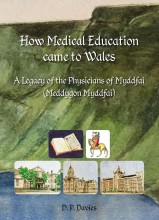
The Physicians of Myddfai
This unique work is of great value to anyone interested in both herbal medicine and the folk traditions of Wales. Although the material dates back to the twelfth century, it is still recognized as a useful and relevant text by present day practitioners as well as those with a more historical perspective.The original physicians of Myddfai date from the twelfth century and their remedies have come down to us in two books, originating from the descendants of Rhiwallon the physician, a short one named The Physicians of Myddfai and a much longer one attributed to Howel the physician. The two books are included in this present collection, together with the famous legend of Llyn-y-Van which claims that Rhiwallon was taught his medicinal art by his estranged mother, the mysterious Lady of the Lake, who predicted his family would be the most skilful physicians in the country for many generations.
Whatever one thinks of the legend printed here, it is a fact that the descendants of Rhiwallon became notable physicians and that as late as the 19th century more than one royal surgeon originated from the little village of Myddfai. The last known practitioner in Wales seems to have been Rice Williams M.D. of Aberystwyth, who died in 1842 aged 85.
This present collection is a facsimile of the English text first published in Llandovery in 1861 and translated into English by John Pughe. From an index spanning Abdominal complaints to a variety of Wounds, this work advises treatments on hundreds of conditions, sufficient to fascinate any reader.